Zirconia crowns in Yerevan
A crown covers the whole tooth, restores its shape and protects it from further damage. Zirconia withstands heavy chewing forces and suits both back and front teeth.
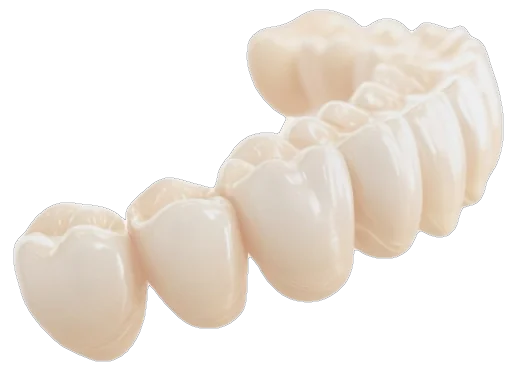
A crown is a fixed restoration that fits over a prepared tooth and fully reproduces its shape. It is used when a filling is no longer enough: when much of the tooth is destroyed, to strengthen a tooth after root canal treatment, and for aesthetic defects that veneers cannot cover.
Zirconia is a strong, wear-resistant material. It withstands significant chewing forces, which makes it especially suitable for back teeth, and it can be used for front teeth too. Crowns come in different shades, and on front teeth the technician can layer ceramic over the zirconia base so that the crown blends in with the neighbouring teeth. The material is biocompatible and as a rule does not cause allergic reactions.
Each crown is made individually from impressions or a digital scan, taking into account your bite and the shape and colour of the neighbouring teeth. Zirconia crowns are usually milled from a digital model, which gives a precise fit. Before that, the tooth is reduced by the thickness of the future crown, preserving as much natural tissue as possible.
If a tooth is already missing, crowns on the neighbouring teeth can be joined into a bridge, or the lost tooth can be restored with a crown on an implant. The prosthodontist at iOrtho in Yerevan will tell you which option suits you after an examination — book a consultation.
Benefits
High strength
Zirconia is wear-resistant and withstands significant chewing forces, so it suits back teeth.
A natural look
The shade is matched to the neighbouring teeth, and on front teeth ceramic can be layered over the base.
Biocompatible
The material is well tolerated by the tissues and as a rule does not cause allergic reactions.
Feels like your own tooth
A fixed crown needs no getting used to, does not shift when you eat or talk and is cleaned like your own teeth.
Protects the tooth
A crown strengthens a tooth after root canal treatment and protects it from further breakdown.
Indications
- More than half of the tooth is destroyed and a filling is no longer reliable
- A large filling, a fracture or a big chip
- Strengthening a tooth after root canal treatment
- Aesthetic defects that veneers cannot cover
- Restoring back teeth that take heavy chewing loads
- A missing tooth, when the neighbouring teeth can support a bridge
Treatment stages
- 1.
Consultation and diagnostics
The prosthodontist examines the tooth, assesses its roots and your bite and, where indicated, orders an X-ray or a CT scan. You discuss the restoration options and the treatment plan.
- 2.
Preparing the tooth
Caries, gum problems and root canals are treated first if needed. A badly damaged tooth is built up for the crown — for example, with a post and core.
- 3.
Preparation and impressions
The tooth is carefully reduced by the thickness of the future crown, and impressions or a digital scan are taken. A temporary crown is usually fitted while the permanent one is made.
- 4.
Making the crown
A dental technician makes the zirconia crown to your individual measurements, matching its shape and shade to the neighbouring teeth.
- 5.
Try-in and cementation
The doctor checks the fit, the bite and the colour, then fixes the crown with a permanent material.
What's included
- Examination and a plan to restore the tooth
- Tooth preparation, impressions or a digital scan
- A temporary crown while the permanent one is made, where indicated
- A zirconia crown made with shade matching
- Try-in, cementation and care advice
Care rules
Clean it like your own teeth
Brush twice a day, including the spaces between the teeth and the gum line around the crown; interdental brushes and a water flosser help.
Professional hygiene
Have regular professional cleanings and preventive check-ups with your dentist.
Sensible loads
Do not crack nuts, fruit stones or hard candy with your teeth: excessive force puts both the crown and the tooth beneath it at risk.
If something feels wrong
If the crown feels loose, or you notice pain or gum inflammation around it, see your doctor without delay.
Questions and answers
Does the tooth have to be reduced for a crown?
Yes. The tooth is reduced by the thickness of the future crown, preserving as much natural tissue as possible. A badly damaged tooth is first built up — for example, with a post and core — and then prepared for the crown.
Is zirconia suitable for front teeth?
Yes. It is used more often for back teeth, but it suits front teeth too: the shade is matched to the neighbouring teeth, and the technician can layer ceramic over the base when needed.
Crown or veneer — which should I choose?
A veneer covers only the front surface and suits minor aesthetic defects on strong teeth. If a tooth is badly damaged, has a large filling or has had root canal treatment, a crown is usually needed. The doctor makes the final decision after an examination.
Can a crown replace a missing tooth?
Yes, in two ways. A bridge rests on the reduced neighbouring teeth but does not prevent bone loss where the tooth was lost. A crown on an implant leaves the neighbouring teeth untouched, and the implant helps preserve the bone. The doctor will choose the right option after an examination.
How long does a zirconia crown last?
There is no exact figure: it depends on hygiene, the load on the tooth and regular check-ups. Zirconia is wear-resistant, and if you follow your doctor's advice the crown lasts a long time.
Book a consultation
Related services
Veneers in Yerevan
Thin ceramic shells for a beautiful, natural-looking smile
Veneers in YerevanImplant crowns in Yerevan
A new tooth in place of a lost one, without reducing its neighbours
Implant crowns in YerevanRemovable dentures in Yerevan
Restoring chewing and your smile after tooth loss
Removable dentures in Yerevan