Implant crowns in Yerevan
The implant replaces the tooth root and the crown replaces the visible part. This restoration stays in place, looks natural and lets you chew properly.
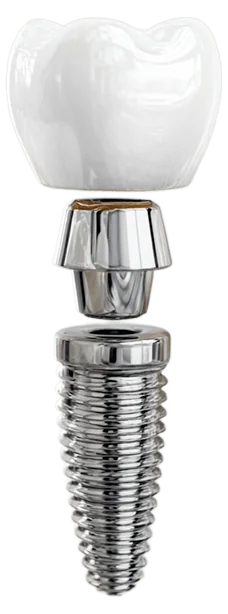
An implant crown is a fixed restoration that replaces a lost tooth — an incisor, canine, premolar or molar. The implant takes the place of the root, an abutment — a connecting part — is attached to it, and on top sits a crown that matches the shape and colour of the neighbouring teeth.
The implant is placed by an oral surgeon, while the crown is made and fitted by a prosthodontist — usually once the implant has integrated with the bone. Before that, a gum former is placed on the implant so that a neat gum contour forms around the future crown. If the implant is stable enough, the doctor may decide to fit a temporary crown earlier.
Implant crowns are made of zirconia or ceramic. Zirconia is strong and withstands significant chewing forces, so it is used more often for back teeth; ceramic reproduces the colour, translucency and texture of enamel most faithfully, which matters especially for front teeth. The material is chosen according to the position of the tooth and your wishes.
Unlike a bridge, an implant crown does not require reducing the neighbouring teeth, and the implant itself helps preserve bone where the tooth was lost. To find out whether this restoration suits you, book a consultation at iOrtho in Yerevan: the doctors will assess your teeth and bone and draw up a treatment plan.
Benefits
A natural look
The crown is matched to the shape and shade of the neighbouring teeth, with no visible clasps or fixings.
Confident chewing
The crown sits firmly on the implant and does not shift when you eat, talk or laugh.
Neighbouring teeth stay intact
There is no need to reduce the neighbouring teeth, as a bridge would require.
Bone preservation
The implant helps preserve bone volume where the tooth was lost, which matters for the neighbouring teeth and facial proportions.
Nothing to take out
The crown does not come out at night or after meals — you look after it like your own teeth.
Indications
- A single missing tooth at the front or back of the mouth
- Several missing teeth in a row — the crowns can be joined into an implant-supported bridge
- Not wanting healthy neighbouring teeth reduced for a bridge
- Not wanting a removable denture
- An implant that has integrated and is ready for a permanent crown
Treatment stages
- 1.
Consultation and planning
The surgeon and the prosthodontist assess the teeth, gums and bone using X-rays and a CT scan, and plan the position of the implant and the future crown in advance.
- 2.
Placing the implant
The implant is placed by an oral surgeon. It then needs time to integrate with the bone; if it is stable enough, the doctor may fit a temporary crown.
- 3.
Shaping the gum
Once the implant has integrated, a gum former is attached so that a neat contour forms around the future crown.
- 4.
Impressions and fabrication
Impressions or a digital scan are taken, the abutment and shade are selected, and a dental technician makes the crown to your individual measurements.
- 5.
Fitting the crown
The prosthodontist attaches the abutment and fixes the permanent crown, checking the bite and the fit at the gum.
What's included
- A joint plan by the surgeon and the prosthodontist
- Impressions or a digital scan and shade selection
- A crown made to your individual measurements
- Fixing the crown and checking the bite
- Advice on care and preventive check-ups
Care rules
Daily hygiene
Brush with the toothbrush and toothpaste your doctor recommends and use a water flosser, especially at the gum line around the crown.
Professional hygiene
Have regular professional cleanings and check-ups so the doctor can monitor the gum around the implant and crown.
Sensible loads
Avoid biting very hard things — nuts, fruit stones, hard candy: the crown is strong, but excessive force can damage it.
If something feels wrong
If the crown feels loose or the gum around it is inflamed and bleeding, see your doctor without waiting for the next check-up.
Questions and answers
When is the permanent crown fitted after implant placement?
Usually once the implant has integrated with the bone. With the classic two-stage method the gum former is placed after 2–4 months in the lower jaw and 4–6 months in the upper jaw, and the permanent crown is fixed about two weeks later. If the implant is stable enough, a temporary crown may come earlier. Your doctor sets the exact timing.
What are implant crowns made of?
Zirconia or ceramic. Zirconia is strong and used more often for back teeth, though it also suits front teeth; ceramic reproduces the colour and translucency of enamel most faithfully. The material is chosen according to the position of the tooth and your wishes.
How does an implant crown differ from a bridge?
A bridge requires reducing the neighbouring teeth, and the bone under it where the tooth was lost keeps shrinking. An implant crown leaves the neighbouring teeth untouched, and the implant helps preserve the bone. Implants are not suitable for everyone, though — the decision is made after an examination.
Does an implant crown need to be taken out?
No. It is a fixed restoration: it does not come out at night or after meals and is cleaned like your own teeth. If it ever needs servicing or replacing, only a doctor removes it in the clinic.
Book a consultation
Related services
Veneers in Yerevan
Thin ceramic shells for a beautiful, natural-looking smile
Veneers in YerevanZirconia crowns in Yerevan
A strong, natural-looking restoration for a damaged tooth
Zirconia crowns in YerevanRemovable dentures in Yerevan
Restoring chewing and your smile after tooth loss
Removable dentures in Yerevan