Bone grafting in Yerevan
If the bone has become lower or thinner after a tooth was lost, the surgeon restores its volume so that an implant can hold securely. The doctor chooses the technique — a sinus lift, guided bone regeneration or ridge splitting — from a CT scan.
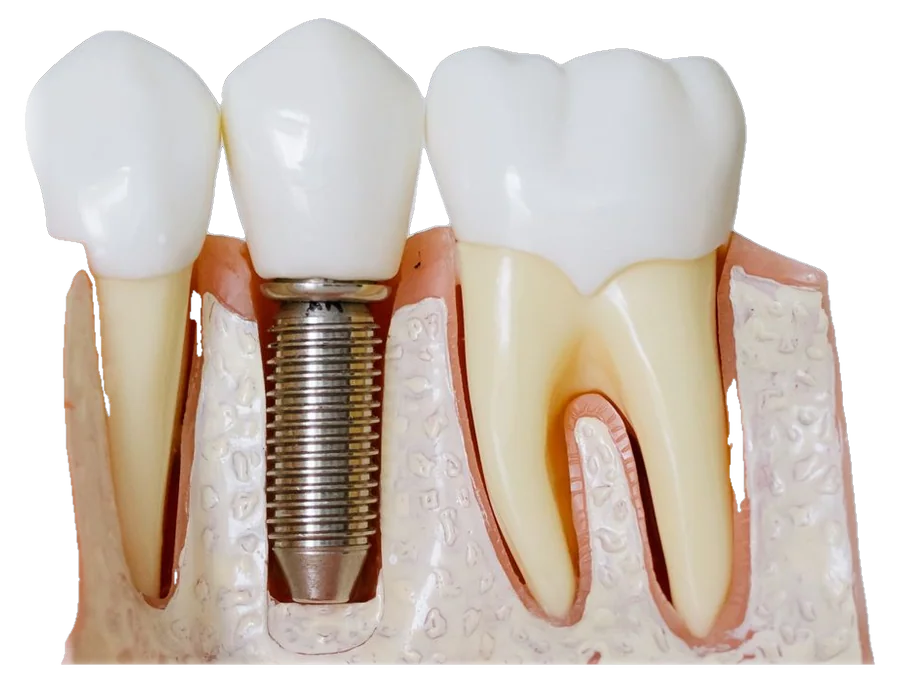
To withstand chewing forces, an implant needs jawbone of sufficient height, width and density. After a tooth is removed, the unloaded bone gradually shrinks — as a rule most noticeably in the first six months, and faster in the upper jaw than in the lower. Periodontitis, chronic inflammation, root cysts and injuries speed this up, as do general conditions such as osteoporosis and diabetes.
When bone is lacking, an implant cannot be anchored securely, the risk of complications rises and its neck may become exposed over time. Bone grafting (osteoplasty) rebuilds the missing volume where the implant is planned. Most often it is part of the preparation for implants, but it is also done on its own — for example, to repair bone defects left by periodontitis.
Techniques
- Sinus lift — in the upper back teeth area the floor of the maxillary sinus is gently raised and the space is filled with bone graft material. The closed approach goes through the implant site when the shortfall is small; the open one goes through a small window in the side wall of the jaw when it is marked.
- Guided bone regeneration — a biocompatible material is placed in the defect as a scaffold for new bone and covered with a membrane; over time it is replaced by the patient's own bone.
- Ridge splitting — a narrow ridge is widened and an implant is placed at once; this works only when the bone is tall enough.
- Bone block grafting — for rebuilding a large volume of bone.
Grafts may use the patient's own bone, synthetic materials, donor bone or materials of animal origin — the doctor chooses the material and the technique from the CT data and your health. With moderate bone loss, grafting is often combined with implant placement. With marked loss it is a separate stage: the graft usually takes at least 4–6 months to heal in, and only then is the implant placed.
Book a consultation at iOrtho in Yerevan: the doctor will assess your bone volume on a CT scan and tell you whether grafting is needed and which technique suits your case.
Benefits
Support for the implant
Enough bone volume allows an implant of the right length and diameter and lowers the risk of complications.
Gum aesthetics
Restored bone helps prevent the implant neck from becoming exposed and the gum from receding over time.
A technique for your case
A sinus lift, guided regeneration, ridge splitting or a bone block — the choice depends on the degree and type of bone loss.
Fewer procedures
With moderate bone loss, grafting can be combined with implant placement when indicated, which shortens the treatment as a whole.
Precise bone assessment
A CT scan shows the height, width and density of the bone and where the maxillary sinuses and the lower jaw nerve lie.
Indications
- Insufficient bone height or width where the implant is planned
- A tooth lost long ago, with bone loss since
- Too little bone below the maxillary sinus when replacing upper back teeth
- Bone defects after periodontitis, inflammation, a cyst or a traumatic extraction
- Bone loss after a jaw injury
- A narrow ridge that cannot take an implant of the required diameter
Treatment stages
- 1.
Diagnostics
The doctor reviews your general health, rules out contraindications and refers you for a CT scan, which shows the density, height and width of the bone and where the sinuses and the nerve lie.
- 2.
Preparation
Before surgery any sources of infection — decay, pulpitis, periodontitis, gum inflammation — are treated and the teeth are professionally cleaned.
- 3.
Choosing the technique
Based on the degree and type of bone loss the doctor chooses the technique and the material and decides whether grafting can be combined with implant placement.
- 4.
Surgery
Under local anaesthesia the doctor rebuilds the bone in the required area, covers the material with a membrane if needed and closes the wound with stitches.
- 5.
Healing and implant placement
The material heals in and is gradually replaced by your own bone — usually over at least 4–6 months. An X-ray confirms the bone is ready, and then the implant is placed if it was not placed together with the graft.
What's included
- Diagnostics and a surgical plan based on CT data
- Local anaesthesia
- Bone grafting with the chosen technique
- Check-ups and an X-ray before implant placement
- Advice on recovery after surgery
Care rules
Food
For the first days eat soft or liquid, warm food and do not chew on the operated side.
Exercise and flights
Avoid exercise, bathhouses and saunas — and, after a sinus lift, flying — until the doctor says it is fine.
Smoking and alcohol
Avoid smoking and alcohol while you heal — this matters for the graft to take.
Hygiene
Brush gently, avoiding the surgical area, and rinse only with the prescribed solution, using gentle movements.
Check-ups and warning signs
Attend every check-up. If swelling or pain gets worse or you develop a fever, contact your doctor straight away.
Questions and answers
Is bone grafting always needed before implants?
No. It is done when a CT scan shows a lack of bone height or width. With one or two missing teeth a narrower or shorter implant is sometimes enough, and with no teeth at all a technique with some implants placed at an angle may be an option. The doctor decides for each case.
What is a sinus lift?
It is bone grafting in the upper jaw in the back teeth area: the floor of the maxillary sinus is raised and the space is filled with bone graft material. With a small shortfall it is done by the closed approach through the implant site; with a larger one, by the open approach through a small window in the side wall of the jaw.
How long after grafting can the implant be placed?
When grafting is a separate stage, the material usually takes at least 4–6 months to heal in, and an X-ray confirms the bone is ready. With moderate bone loss, grafting and implant placement are often done in one operation.
What is the bone graft made of?
It may be the patient's own bone, synthetic material, donor bone or material of animal origin. The material acts as a scaffold that is gradually replaced by your own bone. The choice depends on the size of the defect and your general health, and the doctor makes it after an examination.
Is bone grafting painful?
The operation is done under local anaesthesia. In the first days afterwards there may be swelling and moderate soreness; the doctor will prescribe medicines and give aftercare advice.